A Boreal Settlement Pattern for a Post-Collapse World | 1being
A Boreal Settlement Pattern for a Post-Collapse World
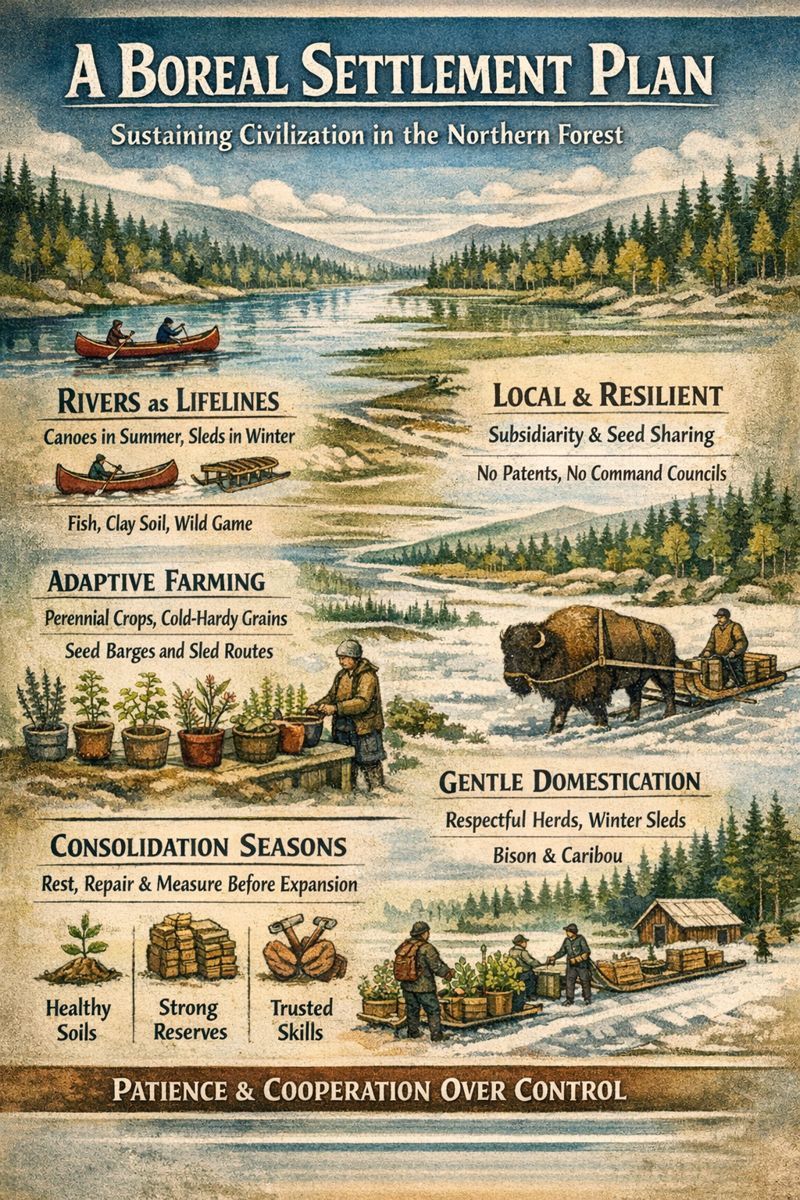
This plan assumes something simple and unfashionable: the boreal forest still works. Rivers still drain north. Clay still holds water. Fish still return. If people align with those facts instead of fighting them, long-term settlement is possible without enclosure, violence, or ecological debt.
The core insight is to treat rivers as infrastructure, not borders. Canoes in summer, sleds in winter. Movement replaces roads. Frozen seasons become transport advantages rather than obstacles. Settlements sit at confluences and clay benches, places proven by history to feed people through fish, game, and soil that holds nutrients.
Calories come first. Fish under ice, rotating traplines, and careful harvest of large fauna that remain mostly wild but accustomed to human presence. No grain dependency early. No overreach. Once survival stabilizes, governance and culture emerge together, grounded in subsidiarity. Decisions stay local unless impact spills outward. Councils coordinate, they do not command.
Plants carry the future. Nurseries start small and spread by water. Seed banks hold Russian almond, Siberian peashrub, pine nut, willow, nettle, gale, berries, and later grains like buckwheat and rye. Distribution happens by seed barges and winter sleds. No patents. Every seed travels with responsibility and teaching.
Competition is used carefully. Friendly contests for the healthiest potted plants evolve into a regional breeding program focused on resilience, yield per litre of soil, and cold recovery. Diversity stays wide. Productivity rises without fragility.
Large animals are never forced. Domestication begins with coexistence. Calm behaviour, winter survival, and mutual benefit matter more than control. Sled routes emerge only after trust between humans, animals, and land is established.
A critical guardrail is consolidation. Cooperative systems fail more often from exhaustion than conflict. This model builds in seasons where expansion stops entirely. Gear is repaired. Seed lots are audited. People rest. Metrics stay boring and honest. Expansion resumes only when buffers are healthy.
Underlying it all is an ethic: land is a human right for subsistence, bounded by care and non-exclusion. There is more than enough land for everyone to live without preventing others from doing the same. Scarcity is usually a coordination failure, not a material one.
This is not a utopia. It is a pattern. One that has worked before, scaled by rivers, memory, and restraint. The boreal forest does not reward speed or conquest. It rewards patience, cooperation, and people who listen longer than they speak.